Northpointe Bank's BJ Maselli finances rental properties and owns them too. He explains when a DSCR loan beats a conventional one, how to strengthen a DSCR file before you apply, and why a price cut can be the most expensive thing a seller offers.
 By BJ Maselli, Branch Manager, Northpointe Bank · NMLS #414709 · Edited by Richard Roy, Publisher · 10 min read
Key takeaways
- A conventional loan qualifies you on personal income; a DSCR loan qualifies the property largely on its rent.
- In BJ's experience, conventional pricing on an investment property mainly pays off with a large down payment, and the rate gap between the two programs has narrowed in recent years.
- Conventional loans go to individual borrowers, not LLCs. Many DSCR programs allow entity ownership.
- Strengthen a DSCR file before you apply: document the rent, balance down payment against reserves, and consider seller credits to buy the rate down.
- For short-term rentals, let comparable properties and seasonal income pick the property, not the other way around.
- Vet the person advising you: license, track record, reviews, and whether they ask about your long-term plan.
In this article
- Two Ways to Qualify for the Same Rental
- When a Conventional Loan Still Wins
- The LLC Question
- Strengthen Your DSCR Before You Apply
- The Price Cut That Costs More Than It Saves
- Growth Takes Cash, Reserves and a Good Operator
- Short-Term Rentals: Let the Research Pick the Property
- Start at the End and Work Backward
- Learn From the Investors Who Get It Wrong
- Before You Take Anyone's Advice
When the housing market slows down, most of the news is about who is sitting it out. First-time buyers wait for rates to fall. Sellers wait for the spring. Lenders talk about application volume.
BJ Maselli hears a different story, because he sits on both sides of the table. He is a Branch Manager at Northpointe Bank in Ohio, where he finances investment properties for clients around the country, and he owns rentals himself.
“Even for me, having investment properties,” he says, “honestly, this is ideal, because I know that I can negotiate to the fullest degree in this kind of market.”
His reasoning is simple. In many markets, homes are sitting longer than they did a few years ago. Sellers get nervous. Some are carrying two mortgage payments while they wait. Every week a listing sits, the person on the other side of the deal gains a little more leverage.
That leverage only helps the investor who can use it, though. And using it starts long before the offer, with how the property gets financed.
Two Ways to Qualify for the Same Rental
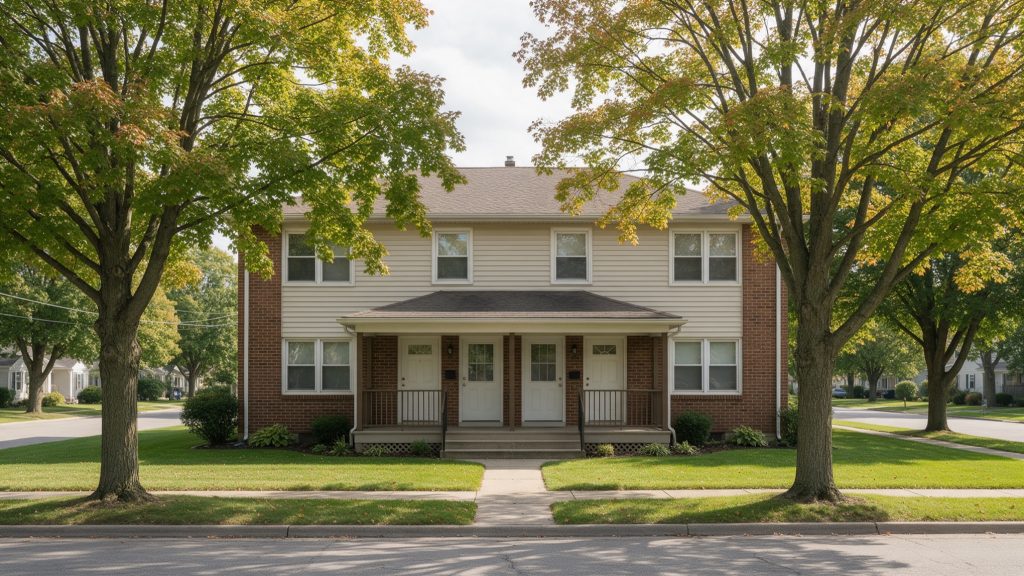
An investor buying a rental can usually qualify one of two ways.
A conventional loan qualifies you. “You’re bringing in your personal income, W-2s, tax returns, that kind of thing,” BJ says. The lender looks at what you earn and what you owe.
A DSCR loan qualifies the property. DSCR stands for debt service coverage ratio: the property’s rent compared with its monthly payment. “DSCR is just based on the rental income of the property,” he says. Your personal income isn’t the deciding number.
Which one is right depends on the investor, not the product. BJ starts with questions: how long you intend to own the property, what your equity strategy is, how many properties you already hold, and how your income shows up on paper.
Many of the investors he works with run several businesses and own several properties. “A lot of times they just don’t want to mess with sending in tax returns, W-2s,” he says. For them, a loan that looks at the rent instead of the return is the cleaner path.
When a Conventional Loan Still Wins
That doesn’t make DSCR the automatic answer. In BJ’s experience, conventional pricing on an investment property tends to earn its keep with a large down payment. “Unless you’re putting probably at least 25% down or more, there’s not really an advantage,” he says.
The math between the two has also changed. “When we started doing this five, six years ago, conventional rates and non-QM DSCR rates were extremely far apart,” he says. Back then he spent more time breaking down the trade-off. Over the last couple of years, the rates for the two programs have moved “way closer together,” so the deciding factors are more often the paperwork, the terms and the investor’s plans.
His bottom line: “Everybody’s situation is different.” A lender who offers one product to every investor isn’t giving advice. Options, he says, with “positives and negatives to both sides,” are the service.
The LLC Question
One difference that surprises new investors has nothing to do with the rate. Conventional loans are made to individual borrowers, not to a business entity. If you want to own a rental in an LLC, a conventional loan generally won’t close that way. Many DSCR programs will.
For BJ, that matters because of how he thinks about risk. “When you have rentals and you have personal assets, you want to keep that stuff separated,” he says.
How much protection an LLC actually gives depends on your state, how the entity is set up and what you sign, so that part of the plan belongs with an attorney. The financing question is simpler: if entity ownership is part of your strategy, tell your lender at the start, because it can decide which loan you’re shopping for.
Strengthen Your DSCR Before You Apply

Because a DSCR loan turns on one ratio, an investor can do real work on the file before the application ever goes in. BJ describes it as an equation. “There’s two sides to every equation,” he says: the income, and the qualifying payment. You can work on both.
Support the rent with evidence. The income side only counts if the lender can document it, so use comparables and the kind of rental-income evidence your program accepts. BJ hears optimistic numbers all the time. A four-unit building rents for $750 a unit, and the owner is sure it could get $1,100. “Don’t just take their word for it,” he says. Have a real estate agent run comparables against what the property actually looks like. Maybe the rent can rise $200 a unit. Maybe it can’t. “You have to know your numbers, because everything is centered around that.”
Decide where your cash does the most work. A bigger down payment lowers the payment and improves the ratio. It also drains the cushion you’ll need when something breaks. BJ lays out the options side by side: what the loan looks like with $25,000 down, with $50,000 down, with $75,000 down, and how much is left in reserves after each. An investor with $100,000 who puts $75,000 down has $25,000 left for repairs and vacancies.
Compare interest-only with principal and interest. Where a program offers an interest-only option, the lower qualifying payment changes the ratio. It also changes how fast you build equity, so it’s a choice to make on purpose.
Use seller credits to buy the rate down. A lower rate means a lower payment, and in a buyer’s market the seller may be the one paying for it. More on that next.
The Price Cut That Costs More Than It Saves

Richard Roy, Local Experts Magazine’s publisher, put a question to BJ about what he sees from listing agents in a slow market: the price drops, then drops again. BJ’s view is that a price cut is often the weakest tool a seller has.
“You drop the price, and then someone, when they make an offer, all they’re going to do is undercut the price drop you just did, because, oh, this person’s desperate,” he says.
His alternative: instead of cutting $25,000 off the price, offer the incoming buyer $20,000 in seller concessions that they can use to buy their interest rate down. The seller keeps more of the price. The buyer gets a lower monthly payment, which matters more to most buyers than the sticker. In BJ’s words, the buyer’s happier “because now they have a low interest rate locked in.”
The same logic works from the buyer’s side. Rather than chasing the lowest price, an investor can ask for a credit and put it toward the rate, which helps the DSCR ratio directly.
Two cautions apply. Concession limits depend on the loan program and on how the property will be used, and investment properties usually have tighter limits than homes the buyer will live in. And the appraisal still has to support the price. Ask your lender what your program allows before you write the offer.
The listing price itself is its own trap. BJ points out that sellers often hire the agent who names the biggest number, not the one who can back it up. A house listed well above its comparables sits for 30, 45, 60 days and ends up selling for less than it would have if it had been priced to draw several offers in the first week. It goes back, he says, to “surrounding yourself with good people,” and checking what they actually know about the market.
Growth Takes Cash, Reserves and a Good Operator

DSCR loans are often pitched as the way to scale a portfolio, because each property can qualify on its own rent. BJ agrees that property-based qualification can support growth. He adds the condition investors tend to skip: “Sustainable growth always requires cash and reserves.” And it depends on “how good is the operator.”
He uses his own rentals as the example. One is a short-term rental with a property manager. The other is a long-term single-family rental he manages himself. Managing it himself saves him the management fee, which adds up over a year.
The short-term rental shows the other side. On the day of the interview he’d received a bill for five or six small repairs that came to several hundred dollars. “Part of me cringes,” he says, because he could have done the work himself for about $75.
But that’s the trade every investor has to price honestly. “Do you have the time? Do you have the knowledge, the skill to do those kinds of things?” Some investors are hands-on. Others make more money in their day jobs and pay people to run the properties. Neither is wrong. What matters is knowing which one you are before you buy the next property, because the answer changes the numbers.
As for self-management, BJ is blunt: “Nobody’s going to do it like you do it.”
Short-Term Rentals: Let the Research Pick the Property

Short-term rentals, such as Airbnb and other vacation rentals, raise the stakes on every point above, because the income swings with the calendar. Programs also differ in what evidence of short-term rental income they accept, so ask before you buy.
BJ’s rule is that the research should choose the property, not the other way around. Too many investors start with a place they’ve always loved. “It’s not, ‘Hey, I want to buy a property right here because I’ve always wanted one,'” he says. “It’s, ‘All right, let’s look at the area, let’s look at the demographic, let’s look at seasonal functionality.'”
That means pulling the comparable rentals. Look at 30 similar properties, he says, and at what they earn in their busiest stretch of the year compared with the slow season. Then measure the property you like against that list.
“All of your research should lead you to a property,” he says. Sometimes the research confirms it: the property checks every box. Sometimes it doesn’t: “This property I really love, but I only checked three of the ten.” The more time you put into the evaluation, the better off you’ll be.
Start at the End and Work Backward

The theme BJ keeps coming back to is planning. He wants to understand a client’s situation “from top to bottom,” including what’s coming. Do you have kids heading to college in two years? Are you planning to retire? Is this property meant to produce cash flow now or equity later? “It’s important to me to kind of start three steps ahead and work backwards,” he says. Otherwise, “you’re just throwing darts out there.”
That shows up in how he handles pre-approvals. “I approve them at their max, and the first thing I say is, ‘I’m not saying buy [at that]… I just want you to know every single option before you start looking at houses.'” Then he walks clients through how the payment changes with property taxes, with the part of town, and with a condo’s HOA dues versus a single-family home. “Education is power,” he says.
It shows up in closing costs, too. One of the most common stories he hears is a buyer who finds out 24 to 48 hours before closing that they need thousands more than they were told. BJ won’t promise a single number at the start. “Until you have all the pieces of the puzzle, you don’t know what the picture is,” he says. He quotes a range of 2.5% to 5% of the price and leans toward the high end on purpose. “I always err on the side of worst-case scenario,” he says, “so that I can bring numbers down.” A title rider, an insurance change or a tax proration left out of the first estimate is how a fixed number turns into a surprise.
Learn From the Investors Who Get It Wrong
BJ works with investors across the country, and he treats every one of them as a source. “I learn just as much from someone who’s got something wrong as I have from investors who do things right,” he says. He has passed along strategies on pricing, renting, listing and marketing that he first saw other investors use. Some investors he worked with seven to ten years ago are still people he talks to regularly: “Tell me what you’re doing now.”
“If you’re not learning, you’re done,” he says.
It’s also why he and his Northpointe colleague James Mahieu, a condo specialist in Florida, work well together. Both of them own investment property. “We’re going through the same uphill battles and good times and bad times investors do,” BJ says. He would put James’s condo knowledge “up against anybody.” (James explained Fannie Mae’s 2026 condo changes in an earlier Local Experts Magazine spotlight.)
That experience is the part he doesn’t think software replaces. Banks are adopting AI tools to summarize scenarios and do some of the heavy lifting, and BJ sees value in that. But when he pictures himself as the customer, he wants a person who has lived it: “the personal knowledge, the education, the success stories, the failure stories. All that comes into play.”
Before You Take Anyone’s Advice
BJ’s closing advice applies whether you’re buying a first rental or your tenth, and whether the person advising you is a lender, an agent or someone on social media promising a mortgage hack.
“Do your research, and research the people that are giving you advice,” he says. “Make sure that they have a proven track record.”
That means looking them up. Check their license, which for a loan officer you can do on the NMLS Consumer Access website. Read their reviews. Ask how many transactions they do. And pay attention to the questions they ask you. Do they want to know your three-year plan? Have they told you what you’ll need at closing?
“If they’re just trying to sell you from day one,” BJ says, “me personally, I run from those people.”
Frequently Asked Questions
What is a DSCR loan?
A DSCR (debt service coverage ratio) loan qualifies an investment property largely on its rental income compared with its monthly payment, instead of on the borrower's personal income, W-2s or tax returns.
When does a conventional loan make more sense than a DSCR loan for an investment property?
It depends on the investor. In BJ Maselli's experience, conventional pricing on an investment property tends to pay off mainly with a large down payment, roughly 25% or more. Investors who would rather not document personal income, or who want to own the property in an LLC, often choose DSCR instead.
Can I close a conventional loan in an LLC?
Generally no. Fannie Mae's Selling Guide makes conventional loans to individual borrowers, not to business entities. Many DSCR programs allow entity ownership. Ask your lender at the start, and talk to an attorney about how an LLC fits your situation.
How can I improve my DSCR before I apply?
Work both sides of the ratio. Support the rent with comparables and the rental-income evidence your program accepts, decide how much cash goes to the down payment versus reserves, compare interest-only and principal-and-interest options where offered, and consider using seller credits to buy down the interest rate.
Are seller concessions better than a price cut?
Often, in a slow market. A credit the buyer uses to buy down the rate lowers the monthly payment, while a price cut can invite an even lower offer. Concession limits depend on the loan program and how the property will be used, and the appraisal must still support the price.
How much should I budget for closing costs?
BJ Maselli quotes a range of 2.5% to 5% of the price and leans toward the high end until every piece of the transaction is known, so the final number comes in lower rather than higher.
Financing a rental property?
Talk to BJ Maselli before you make the offer. He compares DSCR and conventional options for investors and will walk you through your numbers.
Source: Interview with BJ Maselli, Branch Manager, Northpointe Bank, conducted by Richard Roy for Local Experts Magazine, 2026. Fannie Mae Selling Guide B2-2-01 (General Borrower Eligibility Requirements) and B3-4.1-02 (Interested Party Contributions). This article is educational and is not a commitment to lend. Loan programs, terms, concession limits and eligibility vary and are subject to credit, income, property and appraisal approval. Nothing here is legal or tax advice; consult an attorney about entity ownership. BJ Maselli, NMLS #414709. Northpointe Bank, NMLS #447490. Equal Housing Lender. Member FDIC.






0 Comments